New Challenges in Tool Management for the 5-Axis Machining Era
In today's high-precision manufacturing industry, 5-axis machining has become an indispensable technology for producing complex surfaces, aerospace components, precision molds, and medical devices. By simultaneously controlling the X, Y, and Z linear axes along with two additional rotary axes, 5-axis machining enables highly complex multi-surface machining in a single setup. However, as part geometries become increasingly sophisticated, the challenges involved in the machining process continue to grow significantly.
Particularly in high-speed machining (HSM) applications, the contact angle between the cutting tool and the workpiece changes continuously, causing cutting forces to fluctuate constantly. As a result, tool wear mechanisms become far more complex and difficult to predict than in conventional 3-axis machining. When machining high-value materials such as titanium alloys, hardened tool steels, and nickel-based superalloys, unexpected tool breakage or excessive wear can lead to surface quality issues, scrapped workpieces, spindle damage, and significant production losses. Therefore, achieving maximum tool life and automated tool management while maintaining peak machining efficiency has become a critical factor in the transition toward smart manufacturing.
Three Major Challenges of Conventional 5-Axis Machining
1. Unexpected Spindle Load Fluctuations
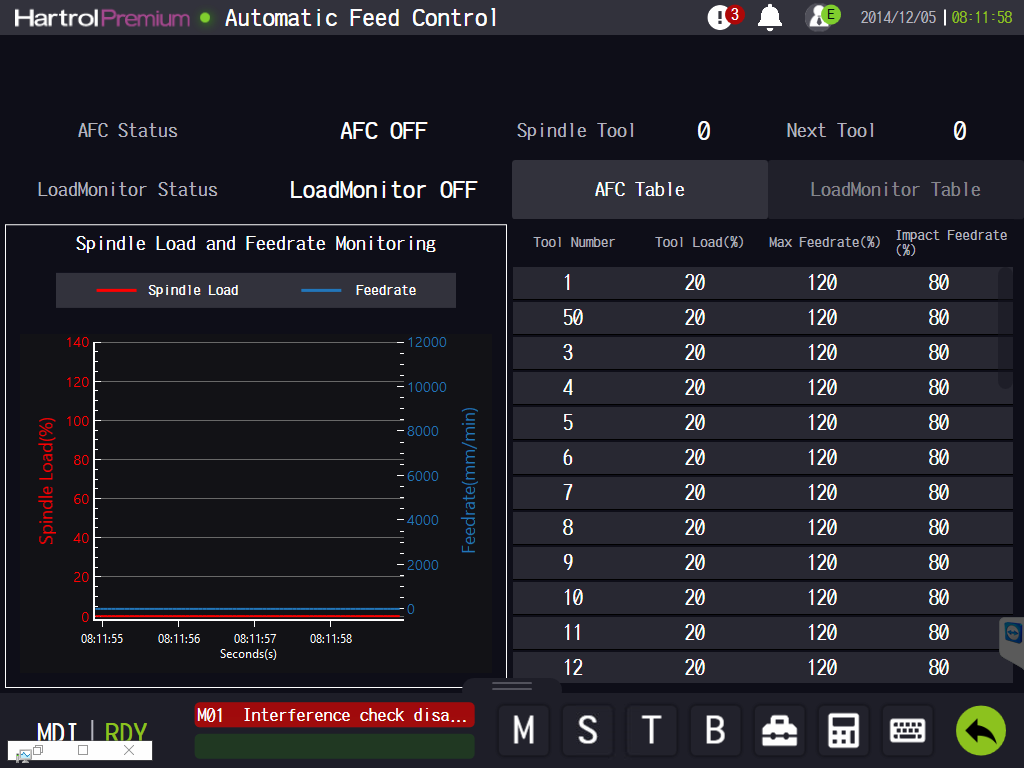
Because cutting depth and tool engagement angles vary constantly during simultaneous 5-axis machining, sudden spindle load spikes can occur without warning, resulting in accelerated tool wear or unexpected tool breakage.
2. Inefficient Manual Tool Tracking
Traditional tool management often relies on operator experience or manual records of tool usage and machining time. These methods are prone to inaccuracies and cannot effectively respond to the dynamic demands of modern multi-axis machining processes.
3. Shortage of Skilled Operators
Experienced machinists capable of setting up complex 5-axis operations and identifying tool wear through cutting sound and machine behavior are becoming increasingly difficult to recruit and train. This growing skills gap directly impacts production stability, machining quality, and overall manufacturing efficiency.